
Can We Trust the Bible?
I believe we can trust the Bible, and I want to explain why in a way that is honest, clear, and useful.
The Bible came to us through a real history. Its books were written across centuries by real people. The church recognized the New Testament canon over time. Scribes copied its words by hand, and translators carried those words into English and thousands of other languages.
That gives us something real to examine. We are not being asked to trust a story with no paper trail, no manuscripts, and no connection to history.
In Are the Gospels Reliable?, I considered whether the four Gospel accounts preserve historically trustworthy testimony about Jesus. This essay asks the larger question. What is the Bible, what do Christians mean when we call it inspired, and what kind of trust does Scripture actually ask from us?
These questions fit together, but they are not all the same question. Manuscripts can help us know whether the words were preserved. They cannot tell us by themselves whether those words came from God. Inspiration does not remove the need to read poetry as poetry or history as history. A trustworthy English translation still involves choices about how to carry Hebrew, Aramaic, and Greek into our language.
If we take those questions one at a time, the larger picture becomes much clearer.
What is the Bible?
The Bible is a library. That is one of the simplest and most helpful things to understand about it.
Its name comes from the Greek expression ta biblia, meaning "the books." When we open it, we do not find the same kind of writing on every page. We find history, law, poetry, wisdom, prophecy, Gospels, letters, parables, family records, prayers, songs of grief, and visions filled with symbols.
The books come from different times and places, but they are not a random pile of religious writings. Together they tell the story of creation, our rebellion against God, His covenant promises, His work of redemption, and the restoration of all things through Jesus Christ.
The Old Testament records God's dealings with Israel and prepares for the Messiah. The New Testament announces Jesus's life, death, and resurrection, then explains the life and hope of the church He established. Jesus described the existing Jewish Scriptures in terms of "the Law of Moses, the Prophets, and the Psalms" and taught His followers to read them as a story fulfilled in Him (Luke 24:25-27, 44-47).
On Adopted Into Glory, "the Bible" ordinarily refers to the 66-book Protestant canon: 39 Old Testament books and 27 New Testament books. That scope should be stated rather than assumed. Roman Catholic and Orthodox Christians receive additional Old Testament books, usually called the Deuterocanonical books or the longer canon. The Orthodox Church in America describes its longer canon directly, and the United States Conference of Catholic Bishops explains the 73-book Catholic Bible.
That disagreement is about the boundaries of the Old Testament. Protestants, Catholics, and Orthodox Christians share the same 27 New Testament books. Early Christians also did not wait for a later council before they had Scripture. Israel already had sacred writings. The first Christians received them, read them in light of Christ, and began sharing the writings of the apostles alongside them.
So the Bible is many books, but it is also one unfolding testimony. The writing styles are different. The central story is one. It reveals the same God, unfolds the same work of redemption, and leads us to the same Christ.
What does inspiration mean?
When Christians call the Bible inspired, we do not mean its writers simply felt creative or deeply moved. Second Timothy 3:16-17 calls Scripture "inspired by God," or more literally, God-breathed. Its message comes from God and serves His purpose of teaching, correcting, training, and equipping His people.
Second Peter 1:20-21 approaches the same reality from the human side. Prophecy did not originate in a prophet's own will. Men spoke from God as they were carried along by the Holy Spirit.
These passages hold two truths together:
- God is the ultimate author of Scripture.
- Human beings genuinely spoke and wrote it.
Inspiration does not mean God dictated every biblical book in the same way. Scripture sometimes records direct divine speech, but Luke investigated sources and composed an orderly account (Luke 1:1-4). The writers of Kings used earlier records. The Psalms grew out of worship, suffering, repentance, and praise. Paul wrote letters to actual churches with actual problems. The author of Proverbs gathered and arranged wisdom.
Nor does inspiration mean that a later copyist, printer, or translator becomes incapable of error. The claim properly applies to the writings as given through their authors. Manuscript comparison and translation remain human tasks. That is why good Bibles include footnotes where the manuscripts differ and why translations are revised when language or textual evidence warrants it.
You may also hear Christians call Scripture infallible or inerrant. Those words are meant to protect a simple conviction: God tells the truth, and Scripture will not fail in what He gave it to say. They do not mean poetry has to sound like a laboratory report, every proverb promises the same outcome in every situation, or every Gospel writer must arrange events in exactly the same way.
Inspiration is a claim about God's action through human authors. Understanding how those authors wrote helps us hear God's Word more faithfully.
Did human authorship compromise divine authorship?
The Bible sounds human because it is human.
Isaiah does not sound like Amos. John does not sound like Paul. Mark moves quickly, Luke writes a carefully ordered narrative, Proverbs compresses wisdom into memorable lines, and the Psalms give us grief, joy, fear, anger, confession, and hope. The writers use their own vocabulary, education, sources, memories, personalities, and circumstances.
I do not see that as a threat to divine authorship. It would be a threat only if God could speak through people by first erasing everything human about them.
Christian theology already has a category for divine action that does not erase genuine human action. God works through human preaching, prayer, witness, and providence. Scripture presents its own production in the same way. David can speak by the Holy Spirit (Mark 12:36), while the words remain recognizably Davidic. What Joseph's brothers intended for evil, God intended for good through the same event (Genesis 50:20). Divine purpose and human agency can operate together without becoming identical.
Human authors make real choices. They select details. They tell events from a particular point of view. They write in the normal patterns of their language and culture. A New Testament writer may quote the common Greek translation of the Old Testament. A Gospel writer may give us the substance of a speech instead of a word-for-word transcript.
But selection is not necessarily deception. Perspective is not necessarily error. A truthful account does not have to contain everything that could be said.
If four people describe the same event, we expect a shared core with differences of emphasis. If a poet says the trees clap their hands, we do not accuse him of failed botany. If Paul writes into a first-century dispute, we first ask what his words communicated there before moving to our setting.
Christians expect the Bible to look human because God chose to speak through humans. Its human form is not a barrier to divine truth. It is the means God chose to communicate it.
How was the canon recognized?
The word canon means a rule or standard. When Christians speak about the biblical canon, we mean the books the church receives as Scripture.
The Bible did not arrive with an inspired table of contents attached to the last page. God's people had to recognize which writings belonged in Scripture. That took place through history, but it was not a careless vote or a contest for political power.
For the Old Testament, the story begins before the church. Israel already received the Law as God's Word, followed by the Prophets and the Writings. By the first century, Josephus could describe a recognized collection of Jewish sacred books. He counted 22 because he grouped some books together, but the material lines up closely with the 39 books in a Protestant Old Testament. The Dead Sea Scrolls show that other valued religious books circulated too, so we should not pretend every Jewish community answered every boundary question in exactly the same way.
The earliest Christians did not begin with an empty shelf. They received Israel's Scriptures and confessed that Jesus fulfilled them. They then preserved apostolic teaching in Gospels and letters. Paul's letters were read publicly and exchanged between churches (Colossians 4:16). Second Peter 3:15-16 refers to Paul's letters alongside "the rest of the Scriptures." First Timothy 5:18 places words found in Deuteronomy and Luke together under "Scripture."
As the early churches weighed Christian writings, several questions mattered:
- Was the writing connected to an apostle or the apostolic circle?
- Did its teaching agree with the faith received from the apostles?
- Was it used broadly and continuously among the churches?
- Did it bear the spiritual and theological character recognized in Scripture?
This was not a checklist that produced an instant answer, and every book did not follow the same path. The four Gospels, Acts, Paul's major letters, and many other books were received early and across wide areas. A smaller group, including Hebrews, James, 2 Peter, 2 and 3 John, Jude, and Revelation, faced questions in some regions. Other writings, such as the Shepherd of Hermas and 1 Clement, were respected and sometimes read in church but were not finally received as apostolic Scripture.
That history is visible rather than hidden. Around the early fourth century, Eusebius distinguished acknowledged, disputed, and rejected writings. In AD 367, Athanasius listed the same 27 New Testament books used today. Regional councils later affirmed what had become the church's settled reception.
The evidence does not show the Council of Nicaea inventing the canon or Constantine choosing the books. It shows a long process in which churches compared claims of authorship, teaching, and use. The disagreements at the edges help us see that process clearly. The church weighed religious writings carefully and preserved the record of where questions remained.
This is why I prefer to say the church recognized the canon. A council did not make an ordinary book become God's Word. If a writing came through God's chosen apostles and was breathed out by God, it already carried authority. The church's responsibility was to recognize and receive it faithfully.
Has the text been preserved?
We no longer possess the original physical manuscript of any biblical book. We do not have Paul's first sheet of Romans or the scroll Jeremiah dictated to Baruch. That is normal for ancient literature. What survives are copies, quotations, translations, and fragments from which the text can be compared and recovered.
For the Old Testament, scholars compare several important witnesses. The Masoretic Text preserves the Hebrew tradition behind most modern translations. The Greek Septuagint was translated before Christ and sometimes points to a Hebrew wording different from the later Masoretic copies. The Samaritan Pentateuch gives us another early form of the five books of Moses.
The Dead Sea Scrolls moved that comparison back roughly a thousand years before the earliest complete medieval Hebrew codices. The Israel Antiquities Authority reports about 230 biblical manuscripts among the scrolls, with fragments of every book in the Hebrew Bible except Esther. Many closely resemble the Masoretic Text. Others agree with readings known from the Septuagint or preserve distinct forms.
The picture is not one of perfect copying with never a letter out of place. It is a picture of strong continuity, with real differences that scholars can see and study.
For the New Testament, we have even more material to compare. The Institute for New Testament Textual Research maintains the official catalogue of known Greek New Testament manuscripts. Some are tiny fragments. Others contain nearly the entire New Testament. They come from different centuries and regions. Ancient Latin, Syriac, Coptic, and other translations add more evidence, along with the many Scripture quotations preserved by early Christian writers.
We should use the numbers honestly. Thousands of manuscripts do not mean thousands of complete Bibles from the first century. Most copies are later, and many preserve only part of the New Testament. What the large number gives us is the ability to compare. If a wording changes in one group of manuscripts, scholars can check it against copies preserved elsewhere. That is far better than having one lonely copy and no way to test it.
Preservation does not mean every surviving copy is perfect. It means the words of Scripture have not disappeared into an unknowable past. For the overwhelming majority of the Bible, the wording is clear. Where a real question remains, responsible translations usually tell us in a footnote.
What do textual variants actually show?
A textual variant is any difference between manuscript witnesses. If one scribe spells a name differently, reverses two words, skips a line, repeats a phrase, or adds a clarification, that creates a variant.
This means two statements can both be true:
- The biblical manuscript tradition contains many variants.
- Most variants make little or no difference to the meaning.
The number grows because we possess many manuscripts to compare. One manuscript would give us no visible variants, but it would also give us no way to check its mistakes.
Most differences involve spelling, word order, omitted particles, or other readings that do not change the translation. A smaller group affects the wording enough to appear in a footnote. A much smaller group involves substantial passages.
The best-known New Testament examples are the longer ending of Mark (Mark 16:9-20) and the woman caught in adultery (John 7:53-8:11). Our earliest and strongest witnesses do not place these passages where they appear in many later manuscripts. Modern translations usually bracket them or explain the evidence in a note.
This is textual criticism working in public. The passages are known precisely because the manuscript tradition preserves enough evidence for its history to be examined.
Some variants are theologically interesting. The wording of John 1:18, Mark 1:1, and 1 John 5:7-8 deserves careful evaluation. Christians should not say that no variant matters.
But no central Christian doctrine depends on one disputed reading. The Trinity, the deity of Christ, His death and resurrection, salvation by grace, and the call to love God and neighbor are taught across many textually secure passages.
Some Old Testament differences are larger because a few books circulated in more than one form. Jeremiah is shorter and arranged differently in the Greek Septuagint. In parts of Samuel, the Hebrew is difficult and the Dead Sea Scrolls or ancient translations sometimes preserve a clearer reading. The evidence gives us both sides of the story: the text was truly preserved, and it came through a real history of copying.
Variants do not prove the Bible was hopelessly corrupted. They show where scribes differed, and the surviving evidence usually allows those differences to be evaluated.
Can translations be trusted?
Yes, good translations can be trusted. But no translation should be confused with the act of inspiration itself.
Translation is necessary because most of us do not read Hebrew, Aramaic, and Greek. Languages also do not line up word for word. One Hebrew or Greek word may have several possible meanings in English. A phrase that sounded perfectly natural to an ancient reader may sound like nonsense if each word is carried over rigidly.
Translators have to make choices about words, grammar, context, and style. Some translations stay closer to the wording and sentence structure of the original languages. These are often called formal-equivalence translations. Others give more weight to expressing the meaning in clear, natural English. These are often called functional-equivalence translations. Every serious translation does some of both. A translation that never interpreted anything would not actually be a translation.
The American Bible Society explains both approaches, while the official ESV and NIV descriptions show how major translations place themselves differently on that spectrum.
This does not mean all translations are equally good for every purpose. A single translator carries more personal judgment than a diverse committee. A paraphrase may be useful for fresh reading but less suitable for close study. Denominational commitments can influence difficult choices. Older translations may use English whose meaning has changed.
A trustworthy practice is simple:
- Read a respected modern translation whose philosophy you understand.
- Compare two or three translations when wording matters.
- Read the translators' footnotes instead of skipping them.
- Use language tools and good commentaries for difficult passages.
- Do not build a doctrine on one English word without checking its context.
The existence of multiple translations is usually a strength. Their agreements show how much of the meaning is clear. Their differences show where interpretation or language requires judgment.
An English reader is not cut off from God's Word. A careful translation communicates Scripture truly, even if no translation communicates every feature of the source text perfectly.
How does genre affect interpretation?
Trusting the Bible includes reading it as it was written.
We already understand this in ordinary conversation. When I say, "The sun rose," nobody thinks I am denying that Earth rotates. If I say, "My heart is broken," nobody calls an ambulance because they think I described a damaged organ. The kind of statement tells us how its words are meant to work.
The same principle applies to Scripture.
Historical narrative reports events, but it also selects and arranges them. Poetry uses imagery, parallelism, emotional intensity, and compression. Proverbs express general wisdom, not mechanical guarantees for every circumstance. Parables tell crafted stories to make a point. Letters address specific communities before they are applied beyond them. Apocalyptic literature uses beasts, numbers, cosmic signs, and symbolic visions.
Genre gives us the rules needed to hear the claims a biblical author is actually making. It helps us receive historical claims as history, poetry as poetry, and symbols as symbols.
Psalm 98 says rivers clap their hands. Revelation describes a dragon sweeping stars from heaven. Jesus calls Himself a door. Nobody reads these statements responsibly by asking whether rivers have palms, whether a zoologist could classify the dragon, or whether Jesus has hinges. The imagery communicates truth through its literary form.
Other passages intend to report history. Paul treats Jesus's resurrection as an event that either happened or did not (1 Corinthians 15:12-19). Calling that passage symbolic would not be a genre-sensitive reading. It would remove the claim Paul is making.
Context means more than reading the verse before and after. We ask what a sentence means in its paragraph, what that paragraph is doing in the whole book, what the original readers would have understood, and how it fits into the larger story of Scripture. We also ask who is speaking. The Bible can truthfully record a lie, an act of violence, or a foolish choice without approving it.
Many alleged contradictions and moral objections become clearer when genre, speaker, covenant, and context are identified. Others remain difficult and deserve patient study. Trust does not require pretending every interpretation is obvious. It requires refusing to blame the text for a reading its author never intended.
What kind of reliability does Scripture claim?
The Bible's claim is stronger than "helpful religious reflections" and more precise than "every sentence answers every modern question."
Scripture repeatedly presents God's words as true, enduring, and worthy of obedience. The psalmist says the entirety of God's word is truth (Psalm 119:160). Jesus says Scripture cannot be broken (John 10:35) and prays, "Your word is truth" (John 17:17). Paul says Scripture was written for our instruction and hope (Romans 15:4).
These claims reach doctrine, moral instruction, historical remembrance, promise, warning, and hope. Scripture asks to be believed because the God who speaks does not lie.
At the same time, biblical truth is communicated through ordinary language and literary conventions. Numbers can be rounded. Events can be grouped by theme rather than strict chronology. One writer can summarize a speech while another preserves different details. A proverb can describe the normal path of wisdom without promising an exceptionless outcome.
So when we ask whether a passage is reliable, we first have to ask what it is actually saying. Did the text truthfully communicate what its human author, under God's direction, intended to communicate?
That keeps us from asking the Bible to be something it never claimed to be. A psalm is not a technical manual. A rounded number is not a failed measurement. A Gospel can arrange true events to emphasize a theme without becoming dishonest.
Truth does not become less true when it is expressed as poetry. History does not become false because it is selectively narrated. Approximation is not error when exact measurement was never intended.
Christians can affirm that Scripture is fully truthful in all it affirms while still doing the hard work of determining what, exactly, a passage affirms.
Why Christians receive Scripture as authoritative
Manuscripts can help us know that the text was preserved. History can help us examine who wrote the books, when they were written, and how they were received. Careful reading can help us understand what a passage means.
Those things matter, but none of them can place a book under a microscope and prove that God speaks through it.
Christians receive Scripture as authoritative because we receive Jesus Christ as Lord.
Jesus lived within Israel's Scriptures. He quoted them in temptation, appealed to them in controversy, treated their commands and promises as God's speech, and declared that they pointed to Him. He commissioned apostles to bear witness to His life, death, and resurrection and promised the Holy Spirit would guide their testimony (John 14:25-26; John 16:12-15).
The authority of Scripture is therefore not an abstract claim floating above Christ. The Old Testament prepares for Him. The Gospels testify to Him. The apostles explain the meaning of His work and the life of His people. Christ stands at the center of the whole.
Someone may ask whether that reasoning is circular: Christians trust Jesus because of the Bible, then trust the Bible because of Jesus. That is a fair question.
My confidence does not rest on one verse announcing that the Bible is inspired. The case includes public history, early testimony, the unity of the biblical story, patterns and promises fulfilled in Christ, the character of Jesus, the evidence for His resurrection, the church's long recognition of these writings, and the Spirit's work through the Word. Faith is not a laboratory experiment, but neither is it a blind leap.
We also see Scripture's authority in the kind of work it does. It does not simply tell me what I want to hear. It exposes my sin, challenges my pride, refuses to let me remake God in my image, centers salvation in grace, and keeps leading me back to Christ. Again and again, Scripture has corrected the church when the church has been willing to stand beneath it.
That authority also keeps Christians humble. Churches and teachers continue learning to read Scripture faithfully. The authority belongs to God's Word, so our interpretations remain accountable to the text, the whole biblical story, and the Christ to whom it points.
So can we trust the Bible?
Yes. We can trust it without denying its human authors, the history of the canon, real manuscript variants, translation decisions, or difficult passages. Those realities call for careful reading, not unbelief. The Bible has been preserved well enough to be known, translated well enough to be read, and given clearly enough to accomplish God's purpose.
Christians receive it not as a magical object and not as a substitute for Christ, but as the Spirit-inspired testimony that leads us to Christ, teaches us His truth, and forms us as His people.
The next question is practical: How to Read the Bible.
Sources and further reading
Scripture and early sources
- Josephus, Against Apion 1.8, on the received Jewish sacred books.
- Eusebius, Ecclesiastical History 3.25, distinguishing acknowledged, disputed, and rejected Christian writings.
- The Muratorian Fragment, an early list of most New Testament books. Its exact date remains debated.
- Athanasius, Festal Letter 39, containing the earliest surviving list that matches the present 27-book New Testament exactly.
Manuscripts, canon, and translation
- Israel Antiquities Authority, Dead Sea Scrolls introduction, on the biblical scrolls, their dates, and their relationship to the Masoretic tradition.
- Institute for New Testament Textual Research, Kurzgefasste Liste, on the official catalogue of Greek New Testament manuscripts.
- Center for the Study of New Testament Manuscripts, "What Is a Textual Variant?", an accessible account of how manuscript differences arise.
- American Bible Society, "How Is Bible Translation Done?", on formal and functional approaches to translation.
- Orthodox Church in America, "Canon of Scripture", explaining the Orthodox longer Old Testament canon.
- United States Conference of Catholic Bishops, "Understanding the Bible", explaining the 73-book Catholic canon and the shared 27-book New Testament.
- Peter J. Gurry and Elijah Hixson, eds., Myths and Mistakes in New Testament Textual Criticism, IVP Academic, 2019.
- Michael J. Kruger, Canon Revisited: Establishing the Origins and Authority of the New Testament Books, Crossway, 2012.
- John H. Walton and D. Brent Sandy, The Lost World of Scripture, IVP Academic, 2013.
Featured artwork
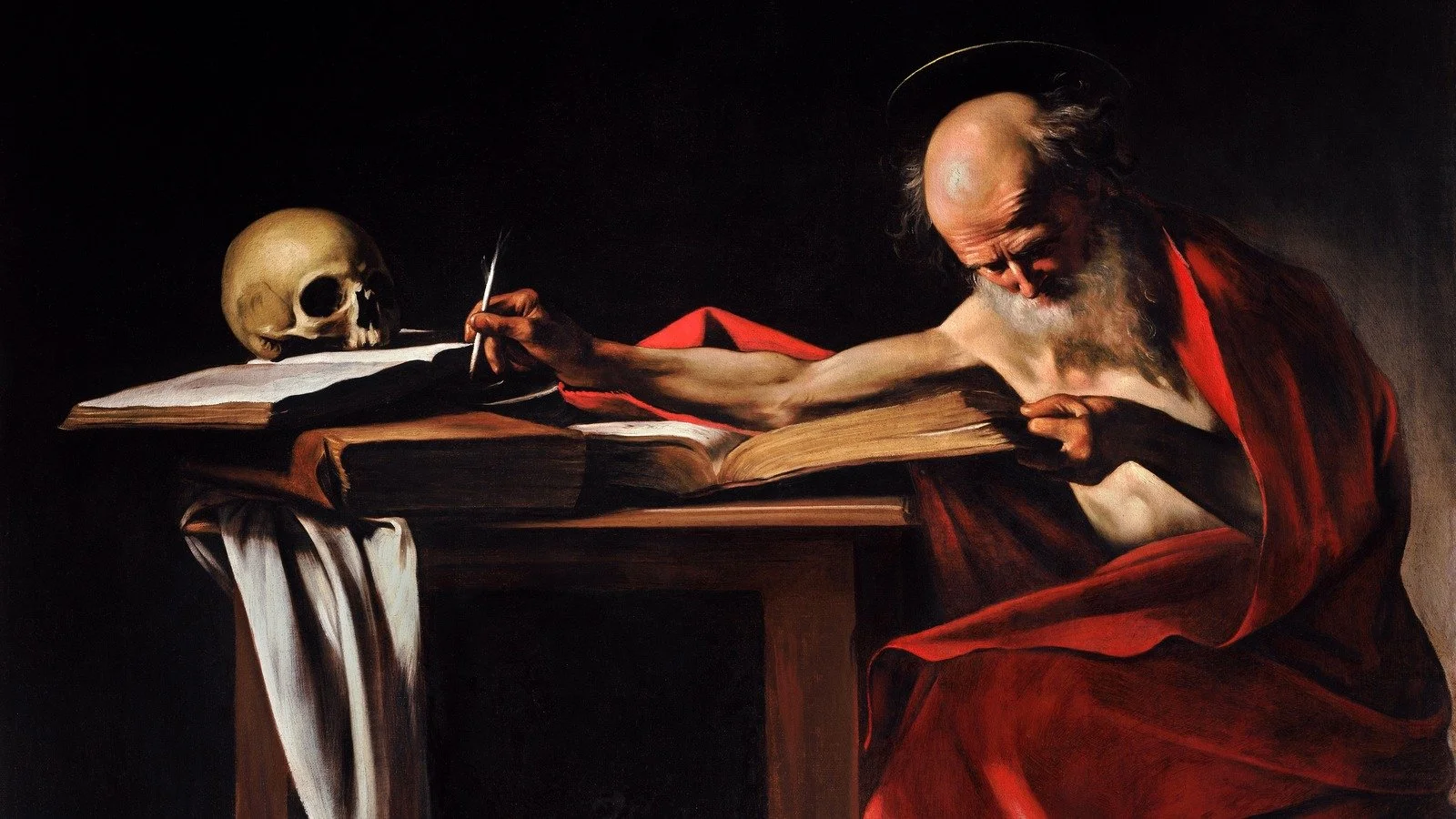
The featured image is Caravaggio's Saint Jerome Writing, painted around 1605 to 1606 and now in the Galleria Borghese in Rome. Jerome is shown working over open books, a fitting image for the serious human labor involved in studying and translating Scripture. The painting and its faithful reproduction are marked public domain.
- Source and rights record: Wikimedia Commons
- Artwork: Michelangelo Merisi da Caravaggio, Saint Jerome Writing, c. 1605-1606, Galleria Borghese, Rome.

.jpg)