
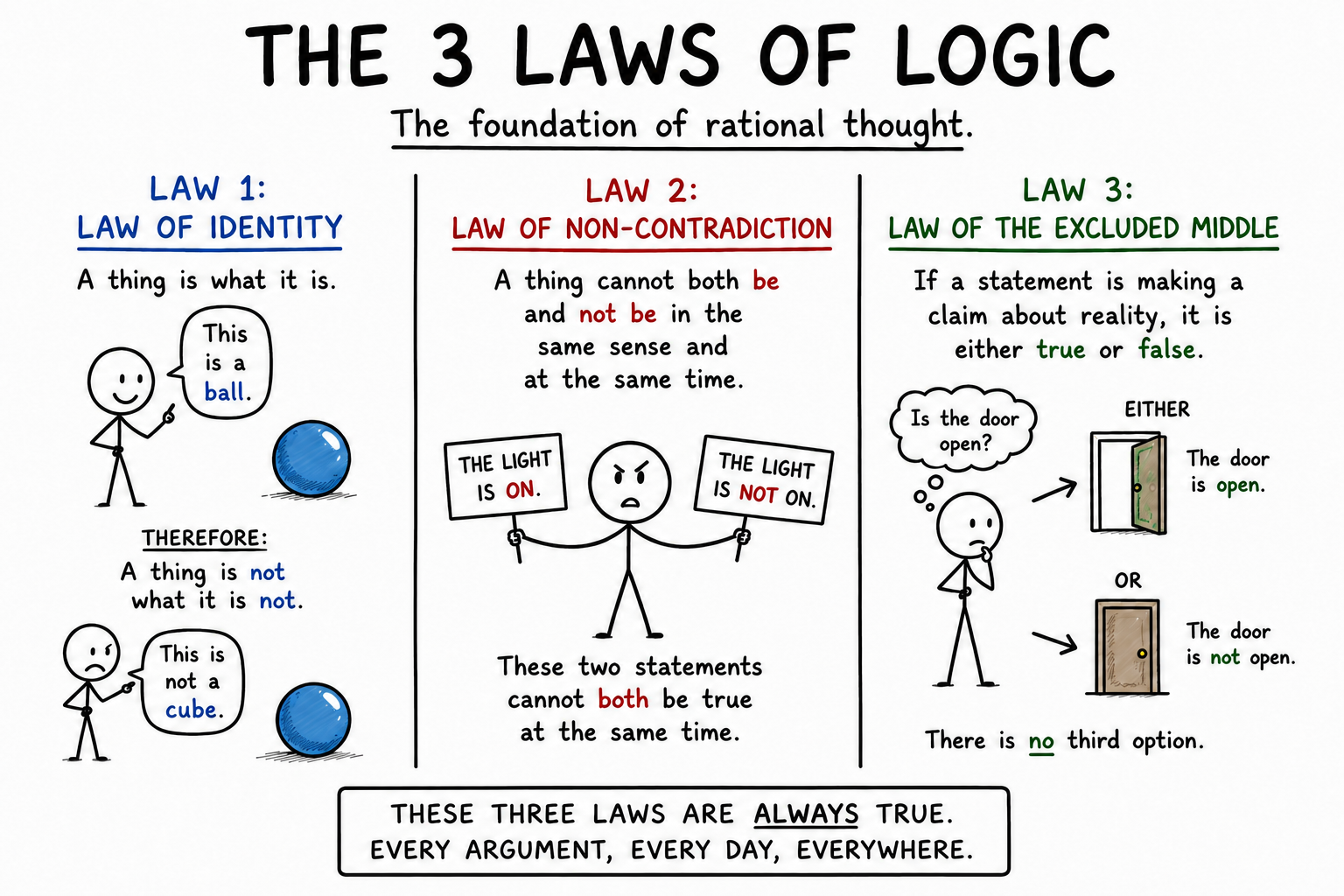
Click on a law to learn more
-
The first law of logic is the Law of Identity.
The simplest way I can think to put it is this: a thing is what it is.
I know that sounds almost too obvious to even talk about, but every meaningful conversation depends on it.
Before you can even know whether a statement is either true or false, you have to know what the person or statement actually means.
It's common for people to be talking past each other. The words you use have to refer to what they are describing. Otherwise, our communication will break down before any conversation can even begin.
For example, an atheist will often argue that faith means believing without thinking or without evidence. But that isn't what Christians mean when they use the word faith.
In the Christian worldview, faith is more like the trust you have that your wife loves you, or that your mom or your children love you. That trust isn't blind. It's based on evidence.
Likewise, the Christian faith is based on historical, philosophical, moral, and logical evidence.
Now, because Christianity makes theological and metaphysical claims, it does not necessarily follow that we should expect physical evidence for every aspect of those claims, especially if God has not purposefully revealed them in that way. Nor does it follow that if someone believes there is no physical evidence today, Christianity must therefore be false. That conclusion simply doesn't follow logically.
But that's a whole other tangent. The point here is that before you can evaluate whether faith is rational or irrational, you first have to define what faith actually means.
If the person you are speaking to attacks a separate position or definition than what you actually gave, they haven't refuted your argument. They've refuted a different one.
This is why defining your terms is so important. If you allow someone else to redefine your position for you, you'll spend the rest of the conversation defending claims you never made.
Always make sure both people are discussing the same claim before evaluating whether it's true or false. If not, you're no longer having a productive conversation. You're talking about two different ideas while using the same words.
We'll revisit this concept when we discuss logical fallacies. For now, just remember this: before evaluating any argument, make sure everyone agrees on what is actually being argued.
So, to review:
A thing is what it is.
If that's true, then we can also conclude something else:
A thing is not what it is not.
That may sound just as obvious, but this simple principle leads us directly into the second law of logic…
-
The second law of logic is the Law of Non-Contradiction.
Simply put, something cannot both be and not be in the same way, at the same time.
For example, I can't truthfully say, "The light is on," and "The light is not on," if I'm talking about the same light at the same moment. One of those statements has to be false.
This law is everywhere. We use it every day without even thinking about it.
Suppose someone says, "Objective truth doesn't exist."
Ask them, "Is that objectively true?"
If they answer yes, they've just admitted that at least one objective truth exists. If they answer no, then there's no reason to accept the statement in the first place.
You'll start noticing this everywhere. People often make claims that, if applied to themselves, immediately collapse under their own weight.
This law also comes up all the time in apologetics.
For example, someone can't consistently claim, "There is no objective truth," and then tell you Christianity is objectively false. If there is no objective truth, then that claim can't be objectively true either.
Likewise, someone can't say morality is completely subjective while also insisting that certain actions are objectively evil. Those two claims can't both be true in the same sense and at the same time.
That's the power of the Law of Non-Contradiction. It doesn't tell you which position is true. It simply tells you that two contradictory positions can't both be true in the same sense and at the same time.
Whenever you hear two opposing claims, ask yourself, "Can these both be true under the same conditions?" If the answer is no, you've just applied the second law of logic.
So, let's review.
A thing is what it is.
A thing cannot both be and not be in the same sense and at the same time.
If those two laws are true, then one final conclusion naturally follows, bringing us to the third and final classical law of logic.
-
The third and final classical law of logic is the Law of the Excluded Middle.
Simply put, if a statement is making a claim about reality, then it is either true or false. There isn't a third option between the two.
For example, if I say, "The light is on," then either that statement is true or it isn't. There isn't a middle category where it's somehow both true and false at the same time.
This doesn't apply to every sentence you can say. Questions, commands, and expressions like "Ouch!" aren't making truth claims. This law applies to statements that are claiming something about reality.
This law doesn't mean we always know which answer is correct. It simply means there is a correct answer.
This comes up all the time in apologetics.
For example, either Jesus rose from the dead, or He didn't. There may be many theories about what happened, but in reality, only one of them can be true.
Either God exists, or He doesn't.
Either objective morality exists, or it doesn't.
We may not always know the answer immediately, but the answer isn't created by our opinions. Reality is what it is, regardless of what we believe about it.
This law reminds us why evidence and reason matter. If there is a truth to discover, then our goal isn't to invent it. Our goal is to follow the evidence wherever it leads.
Now let's put all three laws together.
A thing is what it is.
A thing cannot both be and not be in the same sense and at the same time.
If a statement is making a claim about reality, it is either true or false. There is no middle ground between contradictory claims.
These three laws form the foundation of logical thinking. Every argument you'll ever hear assumes them, even when the person making the argument doesn't realize it.
With these tools in hand, we're ready to move on to the next step: learning the logical fallacies people use, often without even realizing it.