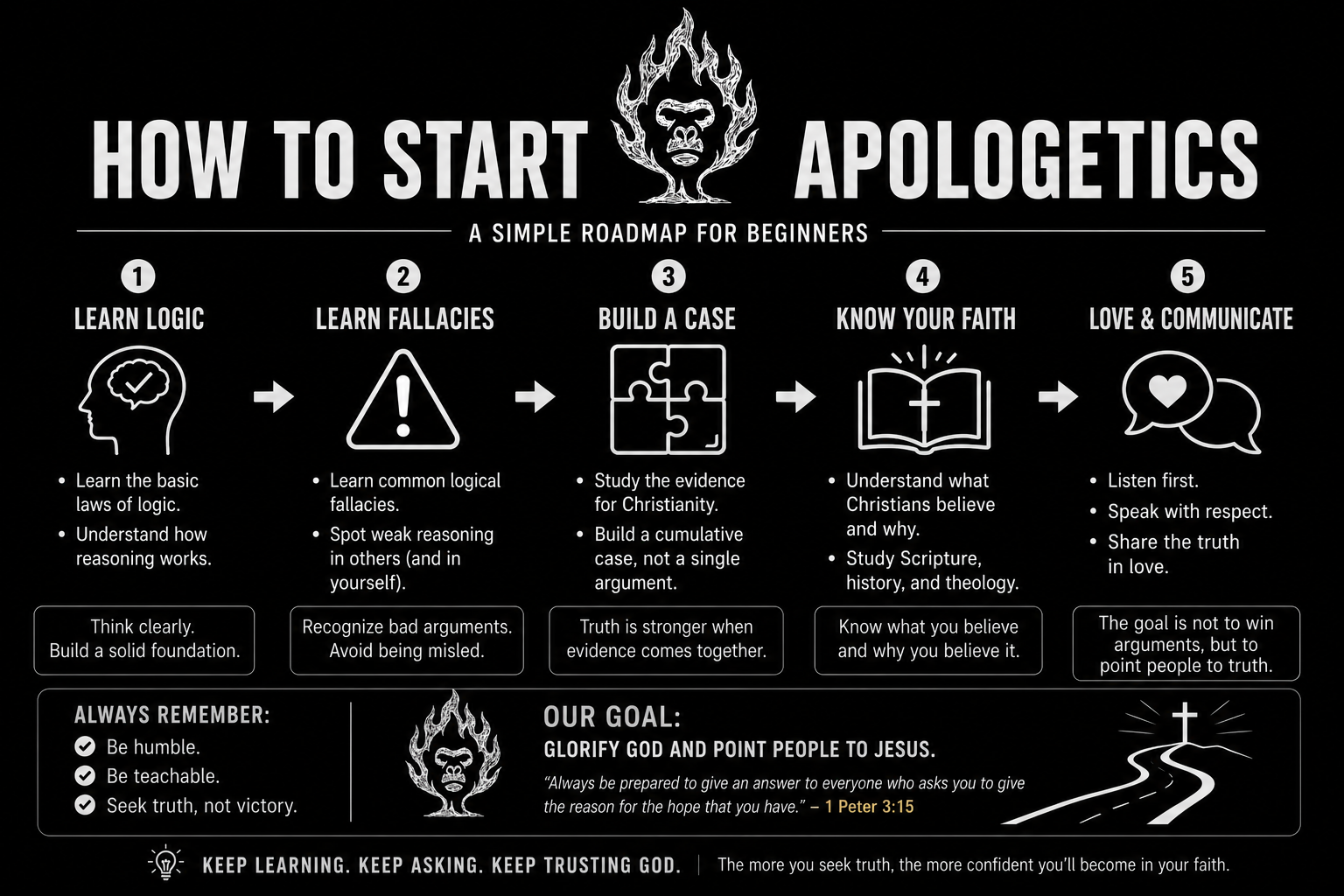
Part 1: Learn Logic
Step 1: Learn the Laws of Logic
Have you ever been scrolling online and come across someone making an
argument against your faith, and you know it's a bad argument, but you can't quite explain why?
You're not alone. Most people don't struggle because they lack information. They struggle because they haven't yet learned how to evaluate arguments critically. Good reasoning requires more than simply asking, "Does this sound right to me?"
That's why the first step in learning apologetics isn't memorizing Bible verses or studying every objection to Christianity. It's learning the basic laws of logic and how to apply them.
Logic is the tool we use to distinguish good reasoning from bad reasoning. It helps us recognize when a conclusion doesn't follow from the evidence, when someone has committed a fallacy, or when an argument contradicts itself.
These principles aren't "Christian logic" or "atheist logic." They are simply the rules of sound reasoning that everyone relies on, whether they realize it or not.
Before we defend what we believe, we should first learn how to think clearly. Once you understand the laws of logic, you'll begin noticing weak arguments everywhere, not just arguments against Christianity, but weak arguments from Christians as well. Truth has nothing to fear from careful reasoning.
Everyone thinks they're logical, and for the most part, most people are. The difference is that many of us reason intuitively rather than intentionally. The goal is to take that intuition and build it into a solid foundation.
Let me ask you a question. Without looking it up, could you name the three classical laws of logic?¹
If not, there's a good chance you haven't yet developed a formal logical framework.
Don't worry if you've never heard of them before. The goal isn't to teach you how to think for the first time. It's to help you recognize the rules your mind is already using so you can apply them intentionally instead of instinctively.
Here's what I mean.
When you're confronted with a cleverly twisted argument, your brain may immediately recognize that something is off, but you can't quite identify what it is or explain why it's wrong. You know the conclusion doesn't sit right, but when someone asks, "Why?" you struggle to pinpoint the exact logical error.
That is where people begin to fumble.
Apologetics is not about winning arguments through clever comebacks. It's about recognizing truth from error and being able to explain why an argument succeeds or fails. Learning the laws of logic gives you the vocabulary and the tools to do exactly that.
So where do we start?
We start with the three classical laws of logic. These are the foundation of rational thought. Every argument, every scientific discovery, every courtroom case, and every theological discussion assumes these principles, whether people realize it or not.
Once you understand these three laws, you'll begin spotting contradictions, false dilemmas, and invalid conclusions much more easily. Arguments that once seemed convincing will often fall apart the moment you examine them through the lens of logic.
And don't think we're learning logic to become argumentative or so we feel intellectually superior. We are learning it so we can love God with our minds, defend the truth faithfully, and help others see it more clearly.
Before you can defend what you believe, you need to know how to think clearly. Logic helps us distinguish good reasoning from bad reasoning, recognize when an argument fails, and build conclusions that actually follow from the evidence.
In this part, you will learn the basic laws of logic, how arguments work, and how to recognize the most common logical fallacies used in conversations about faith.