Does God Exist?
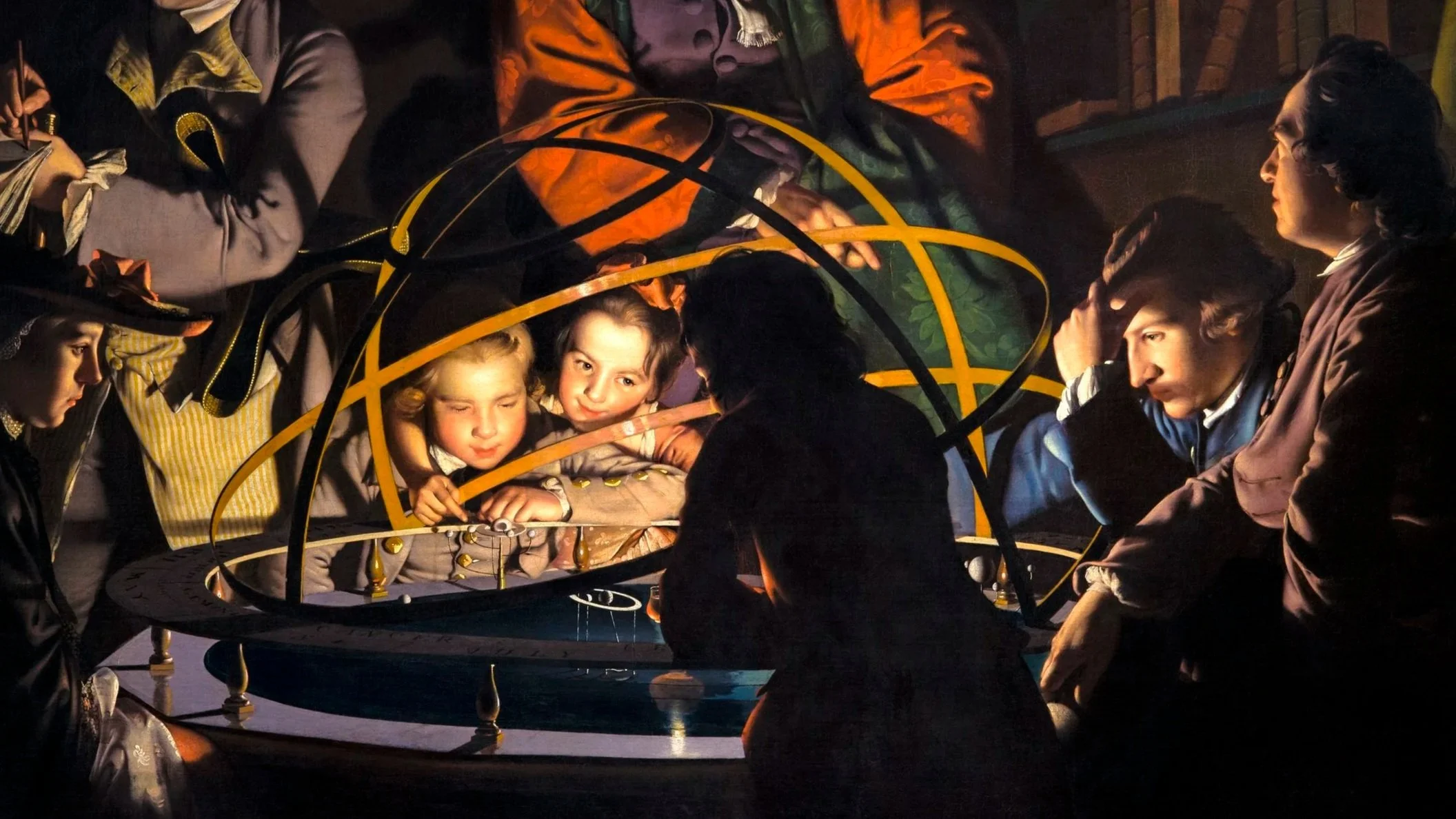
A Philosopher Lecturing on the Orrery, Joseph Wright of Derby, 1766. Public domain.
A Cumulative Case for the Foundation of Reality
Jump to a Section
The Cumulative Case
The Kalam Cosmological Argument
The Argument from Contingency
The Teleological Argument
The Fine-Tuning Argument
The Transcendental Argument
The Ontological Argument
The Moral Argument
Consciousness and Personhood
Eternal Relational Love
Evil and Suffering
Does This Prove Christianity?
Conclusion
Christianity does not ask people to shut off their minds and believe in God because believing feels good.
It makes a claim about reality.
God exists. He created the universe. He is the foundation of everything that exists, and without Him, nothing else could exist at all.
That claim should be examined.
But so should the alternative.
The person who rejects God does not get to stand in some perfectly neutral position while the Christian carries the entire burden of explaining reality. Atheism and naturalism also make claims about what ultimately exists. They must explain why there is something rather than nothing, why the universe follows rational laws, why those laws permit life, why human minds can discover truth, and why objective moral duties seem to press themselves upon us.
The question is not whether Christianity can produce a mathematical equation with “God” written at the end.
The real question is this:
Which worldview best explains the reality we actually experience?
The Cumulative Case
No single argument has to carry the entire case by itself.
Think of a courtroom. One fingerprint may be challenged. One witness may be questioned. One motive may not be enough. But when several independent lines of evidence point in the same direction, the cumulative case becomes much harder to dismiss.
That is how I think the case for God should be approached.
The beginning of the universe points toward a cause beyond the universe. Contingent reality points toward a necessary foundation. Order and fine-tuning point toward intelligence. Logic, morality, consciousness, and love fit naturally within a reality grounded in an eternal, rational, personal God.
The heavens declare the glory of God, and the sky proclaims the work of His hands (Psalm 19:1). Paul likewise says that God’s eternal power and divine nature can be understood through what He has made (Romans 1:20).
Those verses are not telling us to ignore evidence. They are telling us that creation is evidence.
The Kalam Cosmological Argument
William Lane Craig has helped bring the Kalam Cosmological Argument back into modern philosophical discussion. Its basic form is simple:
Whatever begins to exist has a cause.
The universe began to exist.
Therefore, the universe has a cause.
The first premise does not say that everything has a cause. It says that whatever begins to exist has a cause. God, by definition, did not begin to exist. Asking “Who created God?” misunderstands the argument.
Nothing has no properties, no power, and no potential. It cannot cause anything. Even a quantum vacuum is not “nothing.” It is a physical state governed by laws.
The second premise is supported both philosophically and scientifically. A real infinite series of past events creates serious problems. If the past had no beginning, then an infinite number of moments would have already had to pass before today could arrive.
Modern cosmology does not settle every philosophical question, but it is at least consistent with a universe that has a past boundary. The Borde-Guth-Vilenkin theorem shows that a spacetime which has, on average, been expanding cannot be extended indefinitely into the past.
It does not prove creation from nothing, and it should not be overstated. It does, however, show that inflation alone does not remove the need for a past boundary.
If space, time, matter, and energy began, their cause cannot itself be made of space, time, matter, or energy. The cause would have to be spaceless, timeless apart from creation, immaterial, enormously powerful, and able to freely bring about an effect.
That does not give us the entire Christian doctrine of God.
But it sounds much more like God than like nothing.
“In the beginning God created the heavens and the earth” (Genesis 1:1).
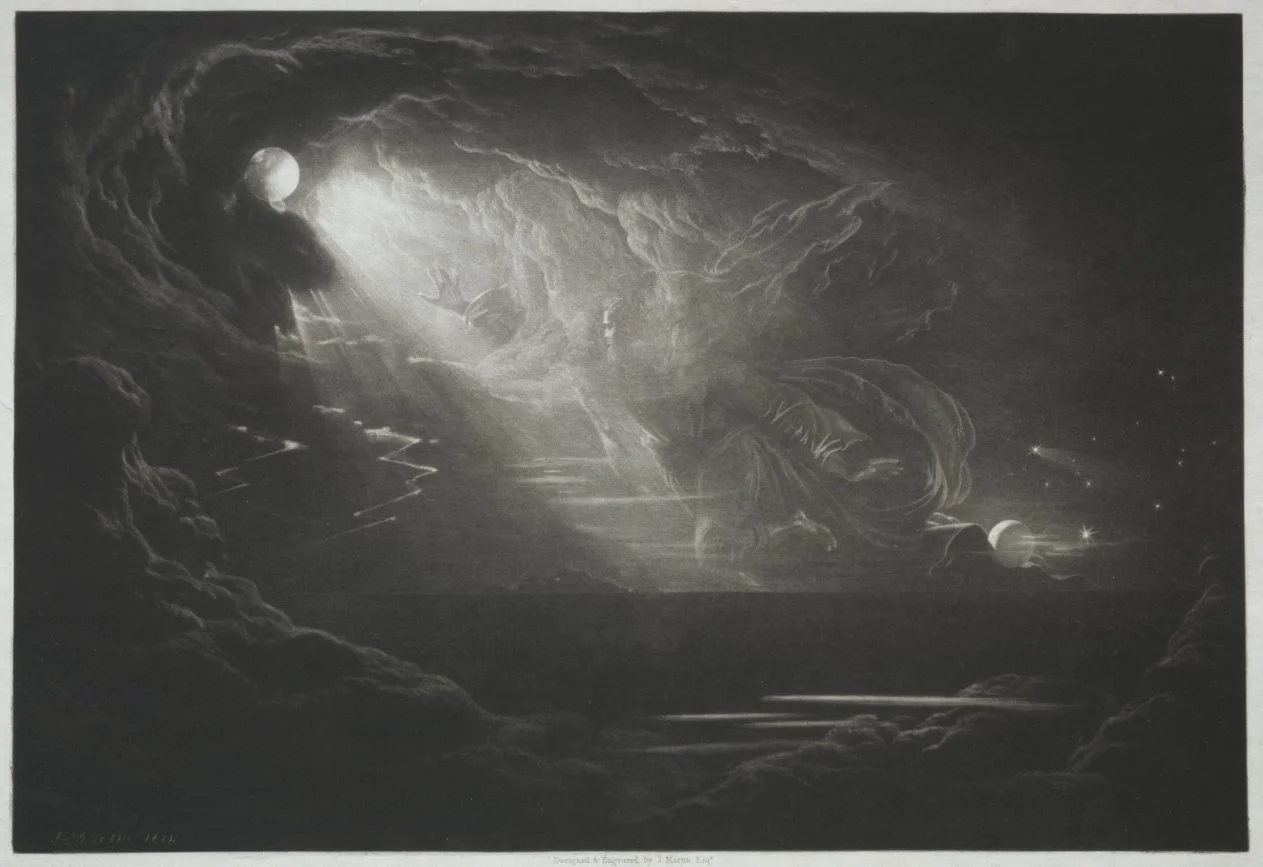
Paradise Lost: The Creation of Light, John Martin, 1824. Public domain.
The Argument from Contingency
The Kalam asks why the universe began. The argument from contingency asks an even deeper question:
Why is there anything at all?
Most things we encounter are contingent. They exist, but they did not have to exist. You could have failed to exist. So could I. Stars form and die. Planets come and go. Even the physical universe appears to contain conditions and laws that could have been different.
If everything were contingent, then everything would depend on something else for its existence. But an endless chain of dependent things never explains why the chain exists in the first place.
Gottfried Wilhelm Leibniz argued that there must be a sufficient reason why something exists rather than nothing. The final explanation cannot be another dependent thing. It must be a necessary reality whose reason for existence is found within itself.
Thomas Aquinas made a related argument centuries earlier. Things in the world receive existence. God does not merely receive existence from something else. God is the uncaused foundation upon which every caused and contingent reality depends.
Bertrand Russell famously replied that the universe may simply be “just there, and that’s all.”
But that is not an explanation. It is a decision to stop asking for one exactly where the deepest explanation is needed.
The Christian answer is not that God is one more object inside the universe. God is the necessary foundation of all reality.
“For from Him and through Him and to Him are all things” (Romans 11:36).
The Teleological Argument
The teleological argument is the argument from order, purpose, and intelligibility.
The universe is not merely a pile of chaos. It behaves in regular ways that can be described through mathematics. Human minds can discover those patterns, reason about them, and use them to make accurate predictions.
Physicist Eugene Wigner called this the “unreasonable effectiveness of mathematics in the natural sciences.”
He was not presenting a Christian argument, but he recognized that the deep fit between abstract mathematics and the physical world is mysterious.
Why should a universe produced by blind, nonrational causes be governed by elegant rational order? And why should minds produced only for survival be capable of discovering truths about distant galaxies, invisible particles, and abstract mathematics?
Science depends on the universe being orderly and the human mind being capable of recognizing truth. Christianity gives us a reason to expect both. A rational God created a rational world and made human beings in His image.
“The heavens were made by the word of the Lord” (Psalm 33:6).
Order does not automatically prove every claim of Christianity. But rational order makes more sense if reality is grounded in mind rather than mindless matter.
The Fine-Tuning Argument
Fine-tuning goes beyond general order.
The universe contains laws, constants, and initial conditions that fall within narrow life-permitting ranges. Change some of them enough and you do not simply get a different kind of life. You lose stable stars, complex chemistry, galaxies, or any usable structure at all.
Astrophysicist Luke Barnes has surveyed the scientific literature and describes the life-permitting region among possible laws, parameters, and initial conditions as very small.
The main proposed explanations are usually physical necessity, chance, a multiverse, or design.
Maybe the constants had to be what they are, but that has not been demonstrated. Chance alone does not explain why the life-permitting result should be expected. A multiverse may increase the number of opportunities, but it also raises questions about the mechanism producing those universes and why that mechanism has the right laws to do so.
Design is not a scientific replacement for studying physical causes. It is a philosophical inference from the kind of universe science has discovered.
If we found one functioning machine among billions of broken arrangements, intelligence would be a reasonable explanation. We should not suddenly treat that inference as irrational when the system in question is the universe itself.
“The heavens declare the glory of God” (Psalm 19:1).
The Transcendental Argument
The transcendental argument asks what must be true for reasoning and knowledge to be possible at all.
Every worldview uses logic. Every argument against God depends on laws such as noncontradiction. A claim cannot be true and false in the same sense at the same time.
But what are the laws of logic?
They are not physical objects. You cannot weigh the law of noncontradiction or place it under a microscope. They are universal, immaterial, and necessary. They do not change when cultures change.
Cornelius Van Til and later presuppositional thinkers such as Greg Bahnsen argued that the Christian worldview supplies the foundation for rational thought. Philosopher James Anderson has also defended the claim that necessary abstract truths fit naturally within the mind of a necessary God.
For a broader academic explanation, see the Stanford Encyclopedia of Philosophy’s entry on transcendental arguments.
The point is not that atheists cannot reason. Of course they can. The point is that they reason because they live in God’s world and possess minds made in His image.
The question is whether a worldview made entirely of changing physical matter can account for unchanging logical laws and our obligation to follow them.
Christianity can.
“In the beginning was the Word” (John 1:1). The Greek word Logos carries the idea of word, reason, and rational expression. Reality begins not with chaos, but with the eternal Logos.
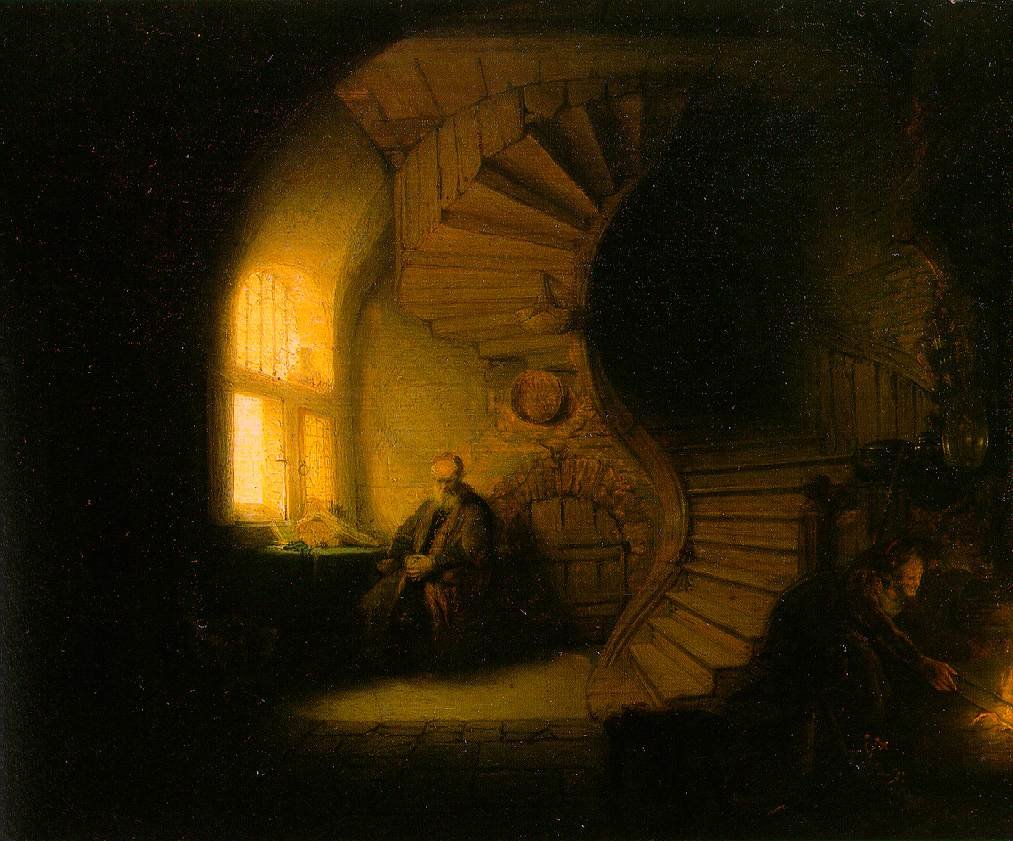
Philosopher in Meditation, traditionally attributed to Rembrandt, 1632. Public domain.
The Ontological Argument
The ontological argument is probably the most abstract argument in this essay, so I do not treat it as the easiest place to begin.
Anselm described God as the greatest conceivable being. Later philosophers, including Alvin Plantinga, developed modal versions of the argument.
In simplified form:
It is possible that a maximally great being exists.
A maximally great being would exist necessarily, not accidentally.
If a necessary being exists in any possible world, that being exists in every possible world.
Therefore, if such a being is genuinely possible, God exists.
The key dispute is the first premise. Is a maximally great being actually possible?
Critics such as Gaunilo, Immanuel Kant, and modern atheist philosopher Graham Oppy have challenged ontological arguments in different ways. Those objections deserve to be taken seriously.
The Stanford Encyclopedia of Philosophy provides a thorough overview of the different versions and objections.
The argument does not define an ordinary object into existence. Necessary existence is part of the kind of being under discussion. You cannot use the same reasoning to prove a perfect island because islands are physical, limited, and contingent by nature.
I would not build the entire case for God on this argument alone. But within a cumulative case, it helps clarify what Christians mean by God: not a powerful being who happens to exist, but the maximally great and necessary foundation of reality.
The Moral Argument
Most people know that some things are actually wrong.
Torturing a child for enjoyment would be evil even if a government approved it, a culture celebrated it, or every surviving person voted for it.
If morality is nothing more than personal taste, biology, or social agreement, then we may dislike cruelty, but we cannot say it is objectively wrong. Evolution may help explain why we developed certain moral feelings. It does not by itself explain why we are truly obligated to obey them.
Atheist philosopher J. L. Mackie understood the force of this problem. He rejected objective moral values partly because he believed they would be strange entities within an atheistic universe.
The Christian argument can be stated simply:
If God does not exist, objective moral values and duties do not exist.
Objective moral values and duties do exist.
Therefore, God exists.
Goodness is not above God, as if He obeys a law greater than Himself. Neither is goodness an arbitrary rule He invented. Goodness is grounded in God’s perfectly good nature.
Human beings have objective worth because we bear His image (Genesis 1:27). Paul says the work of the law is written on human hearts, while conscience bears witness (Romans 2:14–15).
We argue about morality because we believe there is a real standard worth arguing about.
Consciousness and Personhood
Matter has size, location, mass, and motion. But your first-person experience is different. You do not merely process information. You are aware that you are processing it.
You experience pain. You think about truth. You form intentions. You recognize yourself as the same person through changing moments.
Describing the brain’s activity is important, but a physical description of neurons firing does not tell us why there is an inner experience at all.
Thomas Nagel is an atheist philosopher, but he has strongly criticized the idea that a purely materialist account can adequately explain consciousness, reason, and value. His position is examined in this Notre Dame Philosophical Review of Mind and Cosmos.
This does not mean every unanswered question about the mind proves God. It means consciousness fits awkwardly within a worldview in which mindless matter is all that ultimately exists.
If ultimate reality is personal and rational, then conscious persons are not a bizarre accident appearing out of something completely unlike themselves. Their existence has a foundation.
“Then God said, ‘Let Us make man in Our image, according to Our likeness’” (Genesis 1:26).

Eternal Relational Love
Christianity says more than that God has power.
“God is love” (1 John 4:8).
Love is relational. Self-love alone is not the highest form of love. Giving, receiving, knowing, and delighting in another are personal relations.
If God were a single person with no eternal personal relationship, then before creation He would not have eternally expressed interpersonal love. He could create someone to love, but then relational love would depend on creation.
The Trinity gives us a deeper answer.
The Father, Son, and Holy Spirit are distinct persons who eternally share the one divine being. God did not create because He was lonely. Love did not begin when the universe began. The Father loved the Son before the foundation of the world (John 17:24).
This does not prove the entire doctrine of the Trinity by itself. Scripture reveals that doctrine. But eternal relational love is exactly what we should expect if the triune God revealed in Scripture is the foundation of reality.
Read more:
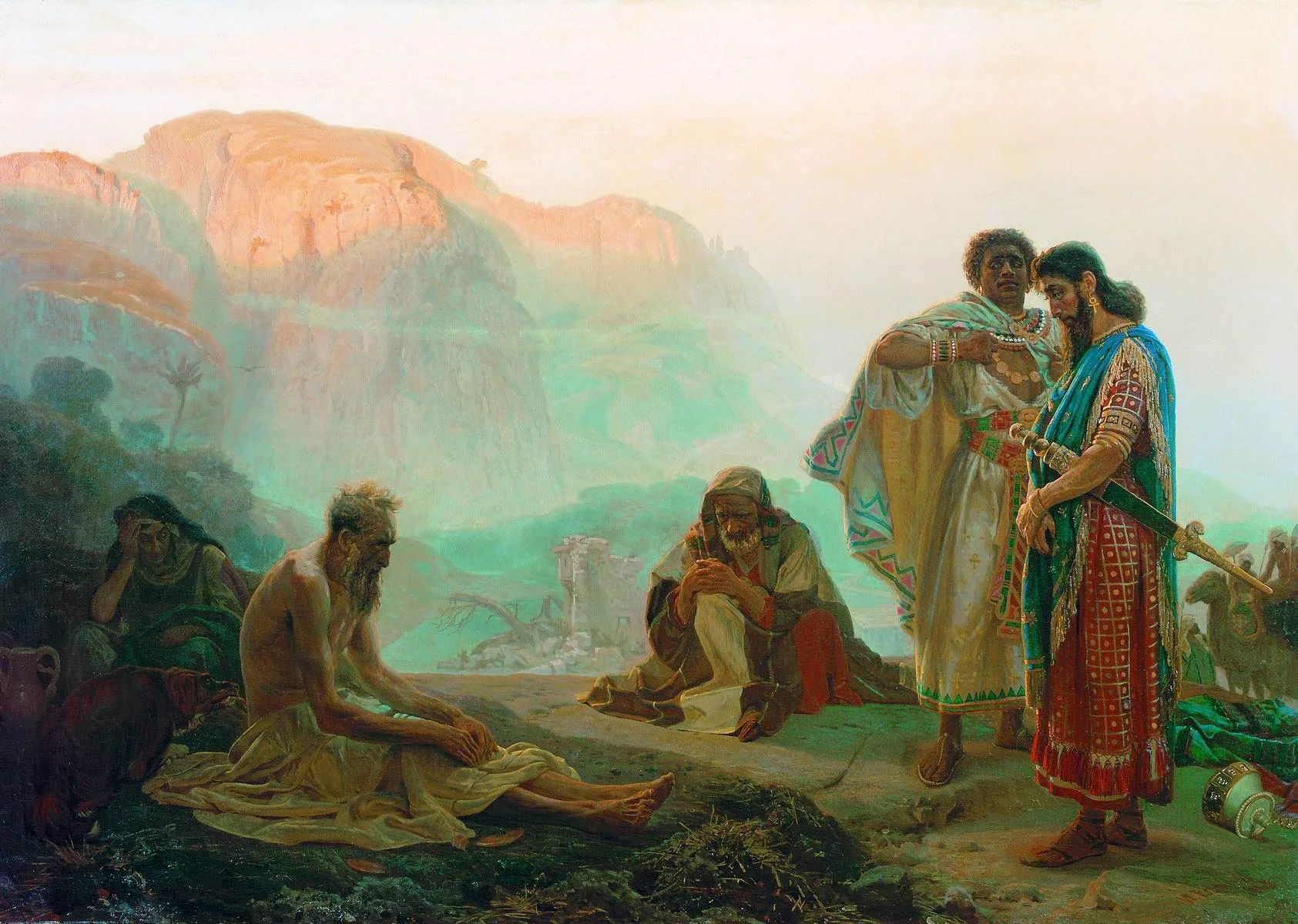
Evil and Suffering
The problem of evil is not a side issue.
People suffer. Children get cancer. Families lose people they love. Any Christian answer that treats this like a cold puzzle has missed the human weight of the question.
But evil is not a simple disproof of God.
To call something truly evil is to appeal to a real moral standard. If suffering is only something our species happens to dislike, then it may be painful, but not objectively wrong. The argument from evil often borrows the objective moral reality that naturalism struggles to ground.
That does not answer every emotional question. It does show that the objection cannot simply assume objective evil while denying any foundation for objective good.
Christianity also does not teach that God watches suffering from a safe distance. In Jesus Christ, God entered human suffering, endured injustice, and faced death.
Augustine argued that evil is not a created substance. It is a corruption or deprivation of the good. Alvin Plantinga’s free-will defense later showed why the existence of God and the existence of moral evil are not logically contradictory.
The Internet Encyclopedia of Philosophy provides an academic overview of the logical problem of evil.
God may have morally sufficient reasons for permitting suffering even when we do not know those reasons. Our limited understanding is not proof that no reason exists.
Christianity does not promise that every wound will make sense right now. It promises that evil will not have the final word.
Does This Prove Christianity?
These arguments do not take us straight from “the universe has a cause” to every doctrine in the Bible.
They build a case for a necessary, eternal, immaterial, powerful, rational, moral, and personal foundation of reality.
That gets us much closer to classical theism than to atheism, but Christianity makes historical claims too.
The next question is whether this God has revealed Himself.
Christianity points to Jesus Christ. It claims that the eternal Word became flesh (John 1:1–3, 14), died for our sins, and rose bodily from the dead.
That historical case deserves its own examination:
The philosophical arguments clear away the claim that belief in God is irrational. The historical evidence asks us to look directly at Christ.
Conclusion
Could someone challenge each of these arguments? Of course.
Philosophers have debated them for centuries. Christians should not pretend every objection is foolish or that every scientific question is settled.
But disagreement is not refutation.
The case for God is not built on one gap in scientific knowledge. It comes from the deepest features of reality: existence, causation, order, fine-tuning, logic, morality, consciousness, personhood, and love.
Taken together, those features point toward an eternal, necessary, rational, moral, and personal foundation.
Atheism can label each feature a brute fact, an accident, or the result of an unexplained universe-generating system. But eventually it still has to answer why any of that exists and why it has the power to produce rational, conscious, morally aware persons.
Christianity gives one unified answer.
“All things were created through Him, and apart from Him not one thing was created that has been created” (John 1:3).
The evidence does not force belief in the way a machine forces an output. God is not asking for blind faith. He calls us to examine the truth, follow the evidence, and seek Him honestly.
If God exists, then this is not merely an interesting philosophical question.
It changes everything.