The Problem of Evil

Does Suffering Disprove God?
The problem of evil is not difficult because philosophers gave it a clever name.
It is difficult because people suffer.
Children get cancer. Families lose people they love. Innocent people are abused. Natural disasters destroy entire communities. Some people pray for help and hear nothing but silence.
Any Christian response that treats this like a cold puzzle has already missed the human weight of the question.
The question is understandable:
If God is all-powerful, all-knowing, and perfectly good, why is there so much evil and suffering in the world?
Christianity should not avoid that question.
The Bible does not avoid it either.
Job questioned God from the ashes of his former life. David repeatedly asked how long God would allow suffering to continue. The prophets cried out against violence and injustice. Jesus Himself wept beside the grave of Lazarus.
Christianity does not tell us that suffering is an illusion.
It tells us that suffering is real, evil is an enemy, creation is broken, and God has acted through Jesus Christ to ultimately defeat it.
JUMP TO A SECTION
What the Problem of Evil Claims
Natural Evil and a Broken Creation
THE WEIGHT OF THE QUESTION
There are really two sides to the problem of evil.
There is an intellectual problem:
How can evil exist if God is perfectly good and all-powerful?
Then there is a personal problem:
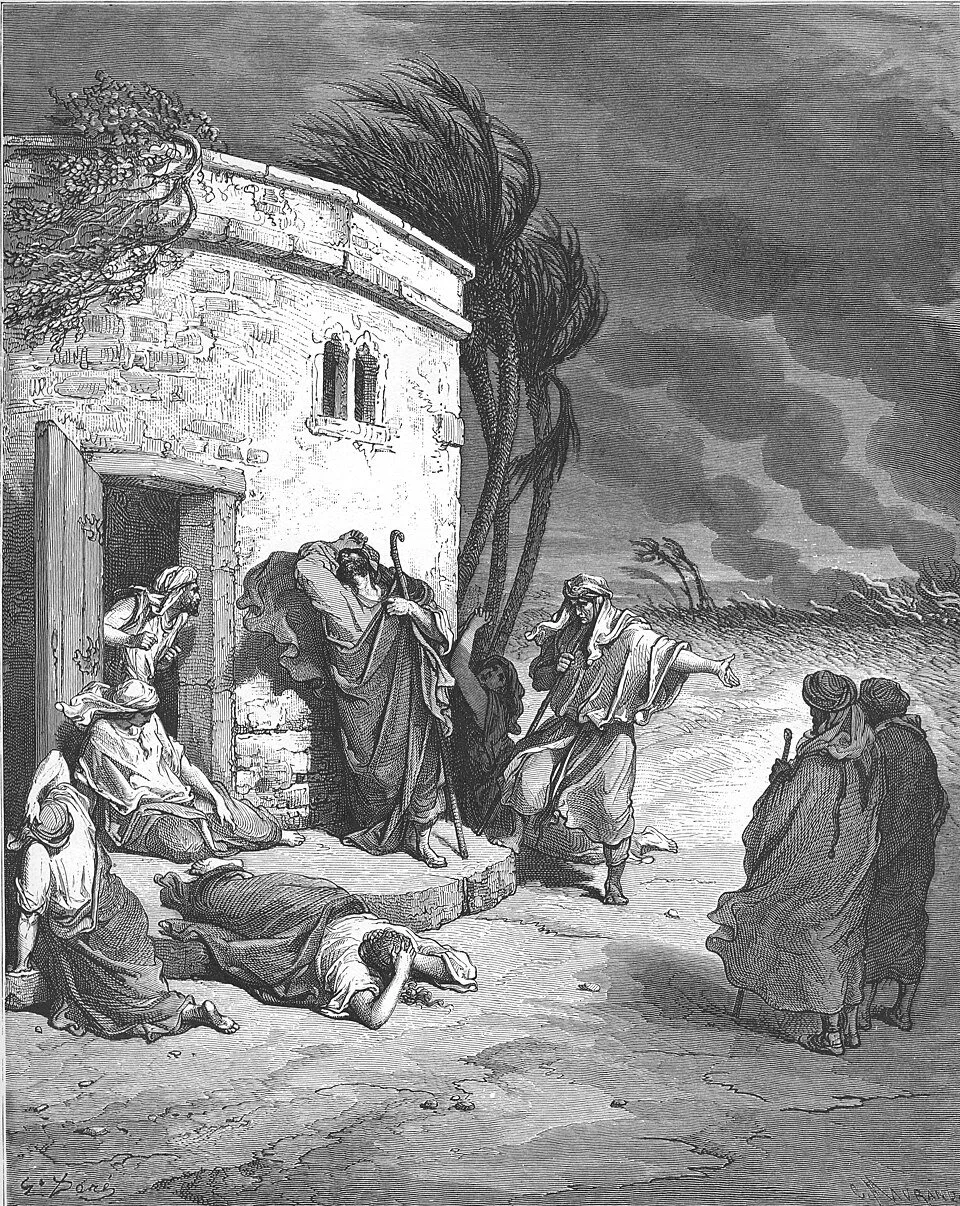
How can I trust God after what happened to me?
A philosophical argument may help with the first question.
It will not automatically heal the second.
A person grieving the death of a child usually does not need to hear a lecture about free will. They need someone willing to sit beside them, listen to them, pray with them, and weep with them.
That is what Jesus did at the tomb of Lazarus.
Although Jesus knew He was about to raise Lazarus, He still entered the grief of those around Him and wept with them in John 11:33–35.
Christianity gives us intellectual answers, but it also gives us permission to grieve.
Psalm 13 begins with David asking how long God will forget him.
The Bible does not rebuke him for asking.
Faith is not pretending pain does not hurt.
Sometimes faith means crying out to God because you still believe He is there to hear you.
WHAT THE PROBLEM OF EVIL CLAIMS
Philosophers normally distinguish between two forms of the problem of evil.
The logical problem of evil claims that the existence of God and the existence of evil are logically incompatible.
The argument usually looks something like this:
God is all-powerful.
God is all-knowing.
God is perfectly good.
Evil exists.
Therefore, such a God cannot exist.
The evidential problem of evil makes a more careful claim.
It does not argue that God and evil are logically incompatible. It argues that the amount, intensity, and apparent pointlessness of suffering make God’s existence unlikely.
That is the stronger form of the objection.
Philosopher J. L. Mackie famously defended the logical version. Alvin Plantinga later responded with what became known as the Free Will Defense.
Plantinga did not claim to explain God’s reason for every tragedy.
His argument was more limited.
If it is even possible that God has a morally sufficient reason for permitting evil, then evil and God are not logically contradictory. Plantinga’s defense is now widely considered successful against the strict logical problem, although it does not settle the harder evidential or personal questions. citeturn909719view1
In other words, evil does not logically prove that God does not exist.
But we are still left asking why God permits so much of it.
That question deserves more than one shallow answer.
What Is Evil?
The Bible begins by declaring creation good.
After creating the world, God looked upon everything He had made and called it “very good” in Genesis 1:31.
Evil was not part of creation as God originally intended it.
Christian thinkers such as Augustine explained evil as a corruption or privation of something good. In other words, evil does not exist as its own independent substance. It exists by damaging, distorting, or removing something that should be there.
Think about digging a hole in the ground.
The hole is real. You can see it, fall into it, measure it, and point directly to it. But the hole is not a new substance that was added to the ground. It is a privation of the dirt that should be there.
Evil works in a similar way.
Blindness is a deprivation of sight.
Disease is a corruption of a healthy body.
Lying is a corruption of truthful communication.
Hatred is the corruption of relationships and love.
Injustice is a deprivation of the justice that should be present.
That does not make evil imaginary or harmless.
A hole is a privation of dirt, but you can still break your leg by falling into it. A wound is a privation of healthy flesh, but it can still kill you.
Evil is real because the damage, suffering, and loss are real.
However, evil cannot exist entirely on its own. It must corrupt something that is first good.
A lie depends upon the good gift of language.
Betrayal depends upon the good reality of trust.
Murder destroys a life that was first good.
Pride twists the good awareness of our value into the belief that we are greater than others or independent of God.
This is why evil is sometimes described as parasitic. It cannot create. It can only corrupt, distort, damage, or destroy what God has made.
Augustine wrote that corruption is evil because it deprives something of the good it was created to possess. Evil therefore does not come from God as though He created a substance called evil. It comes from created wills turning away from the good and using good things against their proper purpose.
The question “Why did God create evil?” therefore begins with a mistaken assumption.
God created people, abilities, relationships, freedom, and a good creation.
Evil entered when created beings turned away from God and corrupted those good things.
But that raises another question.
Why did God give us the ability to turn away at all?
Freedom and Moral Evil
Much of the evil in the world comes from human choices.
War, murder, abuse, exploitation, betrayal, oppression, and cruelty are not normally caused by a lack of divine power.
They are caused by people misusing the freedom and abilities God gave them.
God could have created creatures that always performed certain actions because they were programmed to do so.
But programmed obedience is not the same thing as love.
Love is not merely an action or an emotional reaction. Love involves the genuine giving of oneself to another. It requires trust, commitment, and a real decision of the will.
For us to truly love God, we must be capable of choosing Him.
But a choice that cannot possibly be rejected is not really a choice.
For us to be able to choose God, we must also be able to choose against Him.
For us to freely obey God, we must also be capable of disobeying Him.
For our decisions to have moral meaning, they must have real consequences. A world where our choices never mattered would also be a world where courage, sacrifice, faithfulness, repentance, trust, and love could not possess the same meaning.
This does not mean evil is necessary in the sense that people must commit it.
Adam and Eve were not forced to rebel.
We are not forced to lie, abuse, hate, or murder.
Evil is not necessary, but the possibility of rejecting God follows from the existence of morally meaningful freedom.
God can create free creatures and command them to choose what is good. But He cannot force a genuinely free choice while leaving it genuinely free.
That is not a limitation on God’s power.
Christians believe logic flows from God’s own nature, character, and wisdom. Logic is not some higher law standing above God and controlling Him. It reflects the rational and consistent nature of who God eternally is.
God cannot lie because lying contradicts His truthful nature.
God cannot become evil because goodness belongs to His nature.
God cannot cease to be God because He cannot deny Himself.
In the same way, God does not perform logical contradictions because contradictions do not describe real actions. They are combinations of words that cancel one another out.
A square circle is not an extremely difficult object for God to create. It is not an object at all. The word “square” denies what the word “circle” affirms.
Likewise, “a choice that is completely determined by God and also freely determined by the person in the same respect” is not an action waiting to be performed. It is a contradiction.
God’s inability to contradict His own nature is not weakness.
It is the perfection and consistency of His character.
The Free Will Defense does not explain every disease, disaster, or individual tragedy. It does show, however, that God may have a morally sufficient reason for creating beings with meaningful freedom, even though He knew that freedom could be abused.
God did not create humanity because He needed our love.
The Father, Son, and Holy Spirit have eternally existed in perfect, relational love.
God created us so that we could freely know Him, love Him, reflect His character, and share in the goodness of life with Him.
Love cannot be forced.
God desires our love, but He does not program us to give it.
He calls us to choose Him.
NATURAL EVIL AND A BROKEN CREATION
Free will helps explain moral evil, but what about suffering that no human being directly chose?
What about cancer, birth defects, earthquakes, disease, and animal suffering?
Christianity teaches that humanity’s rebellion affected more than our private spiritual lives.
Creation itself became disordered.
Genesis 3 describes humanity’s separation from God and the entrance of death, conflict, pain, and disorder into human experience.
Paul later writes that creation was subjected to futility and now groans while awaiting restoration in Romans 8:18–25.
The world remains good in many ways, but it is not operating exactly as it should.
Our bodies can heal, but they can also become diseased.
Rain can nourish crops, but storms can destroy cities.
Tectonic activity helps sustain a living planet, but earthquakes can kill thousands.
The natural systems that make embodied life possible can also produce suffering within a broken creation.
This does not mean that every tragedy is God’s punishment for a specific sin.
Jesus directly rejected that assumption.
When His disciples saw a man who had been blind from birth, they asked whether the man or his parents had sinned. Jesus told them that his blindness was not caused by either of those things in John 9:1–3.
Jesus made a similar point in Luke 13:1–5. The people killed in tragedy were not worse sinners than everyone else.
A child does not develop cancer because that child was more sinful than another child.
A family does not lose its home in a tornado because God hated them.
We live together in a creation affected by sin, death, decay, and human rebellion.
The consequences fall upon the guilty and innocent alike.
Why Does God Not Stop It?
This is usually the hardest part of the question.
Even if freedom and a broken creation explain how suffering became possible, why does God not intervene more often?
Why stop one tragedy but allow another?
Why answer one prayer while another desperate prayer appears unanswered?
No honest Christian can claim to know God’s exact reason for allowing every individual tragedy.
The Bible does not give Job a detailed explanation for everything that happened to him. Instead, Job is confronted with the difference between his limited perspective and God’s complete knowledge.
That can sound unsatisfying, especially when someone is hurting.
But the basic point matters.
Our inability to see a sufficient reason does not prove that no sufficient reason exists.
We see a small part of reality.
God sees every event, every consequence, every person affected, every future decision, and the final outcome of history.
That does not mean we should look at every tragedy and confidently claim we know the hidden good God intends to bring from it.
Sometimes we simply do not know.
Christianity does not require us to invent an explanation where God has not given one.
We can also ask what kind of world would exist if God prevented every harmful consequence before it occurred.
Meaningful choices require a world in which actions have real effects.
If betrayal never damaged trust, cruelty never caused pain, neglect never harmed anyone, and selfishness never carried consequences, then our choices would lose much of their moral significance.
We would still be capable of intending evil, but the world would constantly be rearranged so that our decisions never truly affected anyone.
That would not be meaningful moral freedom.
It would be something closer to living inside a protected simulation where every serious consequence was automatically erased.
A stable world also requires regular cause and effect.
The same physical order that allows us to walk, build homes, grow food, study creation, and care for one another also allows our bodies to be injured and our actions to affect the world.
None of this tells us why God permitted one specific child to become sick or one specific family to experience tragedy.
At that point, we must be honest about the limits of our knowledge.
The Christian answer is not that suffering does not matter.
It is that God knows what we do not, remains present in what we cannot understand, and has revealed His character most clearly through Jesus Christ.
GOD CAN REDEEM WHAT HE DOES NOT APPROVE
Christians sometimes say, “Everything happens for a reason.”
That statement can be misleading.
It can sound as though every act of abuse, murder, disease, and cruelty was directly caused by God because He wanted it to happen.
The Bible makes a more careful distinction.
God can permit something He hates and still bring good from it.
When Joseph’s brothers sold him into slavery, their actions were evil. Years later, Joseph told them:
“You planned evil against me; God planned it for good.”
The same event involved two different intentions. Joseph’s brothers intended harm. God worked through their evil choices to preserve life. See Genesis 50:20.
God bringing good from suffering does not make the suffering good.
Growth does not excuse abuse.
Courage does not make danger good.
Forgiveness does not make betrayal acceptable.
Healing does not mean the wound should have happened.
The good is found in what God creates from the ruins, not in the evil itself.
Suffering can produce endurance, compassion, humility, courage, and dependence upon God. Paul speaks about God working all things together for the good of those who love Him in Romans 8:28.
That passage does not say all things are good.
It says God is able to work through all things for good.
Evil may damage God’s creation, but it cannot place creation beyond His ability to redeem.
God Entered Our Suffering
Christianity does not present us with a God who watches human suffering from a safe distance.
God entered it.
The eternal Son took on human flesh.
The Creator stepped into His creation.
Jesus experienced hunger, exhaustion, grief, betrayal, rejection, injustice, torture, and death.
He was betrayed by a friend.
He was abandoned by His followers.
He was falsely accused, publicly humiliated, beaten, mocked, and crucified.
At the cross, God did not merely give humanity an explanation of suffering.
He stepped into it.
Consider what happened.
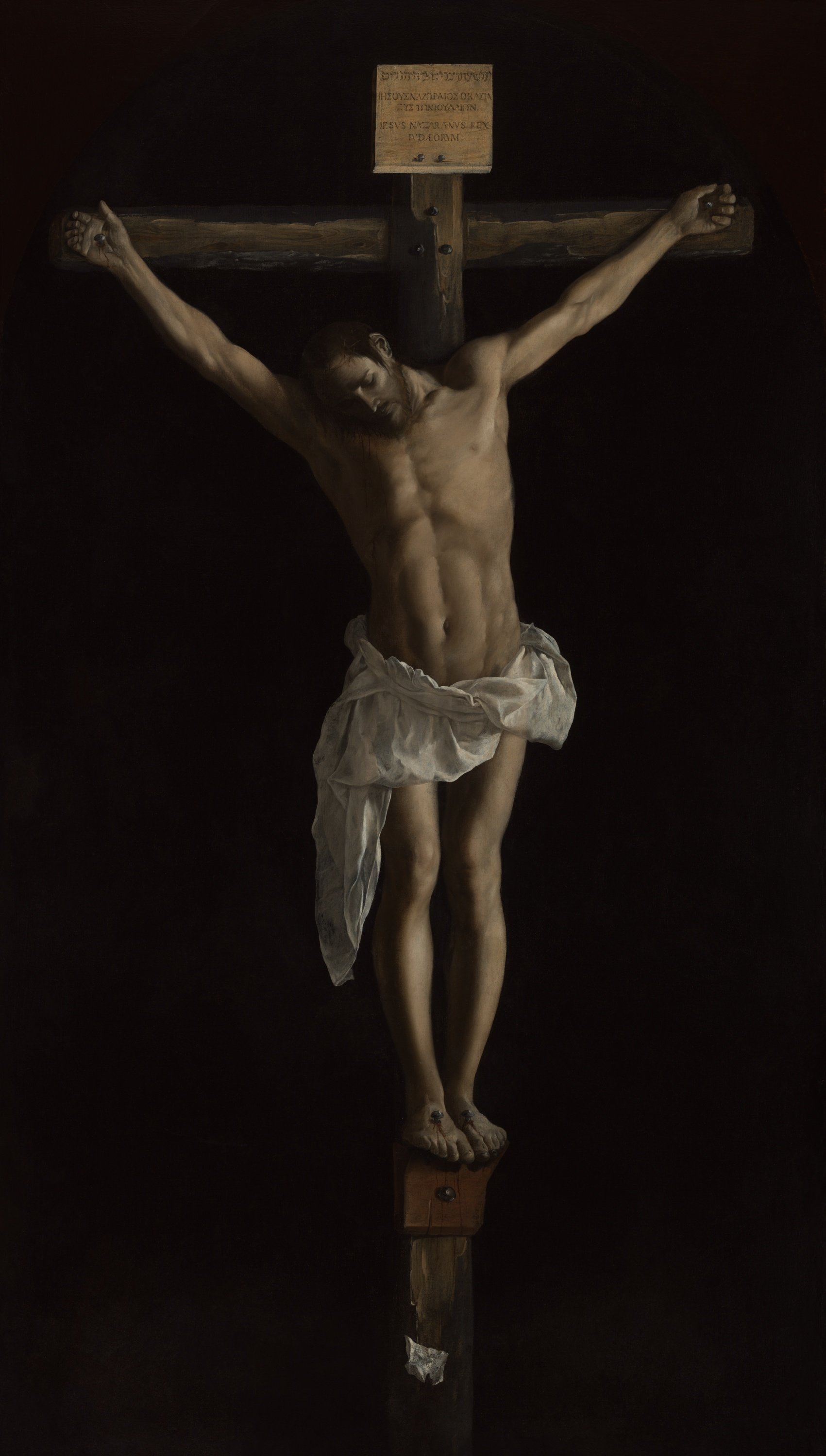
The Crucifixion, 1627, by Francisco de Zurbarán. CC0 public domain, Art Institute of Chicago.
The Creator of the universe came into the world in human flesh, and the creatures He made rejected Him, tortured Him, and nailed Him to a cross.
The only truly innocent man who ever lived was condemned as guilty.
Humanity murdered the Author of life.
God and humanity could be reconciled.
Death itself would be defeated through the resurrection.
The evil of the crucifixion did not become good. Judas’s betrayal, the false accusations, the political cowardice, the torture, and the execution all remained evil.
But evil could not stop God.
God took the act meant to silence Jesus and made it the means through which the Gospel would be proclaimed to the world.
The cross therefore reveals something central to the Christian answer to evil:
God does not need evil in order to accomplish good, but evil is never powerful enough to prevent Him from accomplishing good.
Human beings can rebel against God’s will, but they cannot overthrow His ultimate purpose.
Peter explains in Acts 2:22–24 that Jesus was handed over according to God’s determined plan and foreknowledge, while the people who crucified Him were still described as lawless.
God’s sovereignty did not remove their responsibility.
Their evil choices did not defeat God’s sovereignty.
The cross does not tell us the specific reason behind every tragedy.
But it tells us something about the God who meets us in tragedy.
He is not indifferent.
He is not unfamiliar with pain.
He knows betrayal.
He knows grief.
He knows what it is to suffer injustice.
The God of Christianity bears scars.
And the resurrection tells us that suffering, evil, and death will not have the final word.
FINAL JUSTICE AND RESTORATION
If death is the end, then countless acts of evil will never be answered.
Many abusers will never face justice.
Many victims will never receive healing.
Many lives will end before anything is made right.
Christianity says history does not end that way.
God will judge evil, raise the dead, restore creation, and make all things new.
The Christian hope is not that suffering will eventually be forgotten because it never mattered.
It will be healed because it mattered deeply to God.
Revelation 21:1–5 describes a restored creation where death, grief, crying, and pain are gone.
This future hope does not make present suffering unimportant.
It makes present suffering temporary.
It also means no person ultimately gets away with evil.
Human courts fail.
Evidence disappears.
Powerful people escape consequences.
God’s judgment will not fail.
Every hidden act will be exposed. Every wrong will be answered. Every person who belongs to Christ will be raised and restored.
The resurrection of Jesus is the Christian promise that death does not receive the final word.
HOW CHRISTIANS SHOULD RESPOND
The problem of evil is not only something Christians should debate.
It is something we are commanded to confront.
We are called to feed the hungry, protect the vulnerable, care for the sick, defend the oppressed, forgive those who repent, and stand against injustice.
We should never use theological answers as an excuse to ignore suffering.
When someone is grieving, we should not rush to explain what God has not explained.
Job’s friends initially did the right thing. They sat silently beside him.
Their trouble began when they started giving confident explanations they could not support.
Romans 12:15 tells Christians to weep with those who weep.
Galatians 6:2 tells us to carry one another’s burdens.
Sometimes the most Christian response is not a speech.
It is presence.
It is bringing food.
It is helping with medical bills.
It is protecting someone from an abuser.
It is listening without trying to fix everything.
It is praying when the suffering person no longer has the strength to pray.
If our theology makes us less compassionate toward suffering, then we have misunderstood our theology.
CONCLUSION
The problem of evil is one of the strongest challenges to belief in God.
Christians should acknowledge that.
But evil does not create a logical contradiction within Christianity.
A world containing genuine freedom allows the possibility of moral evil.
A creation separated from God experiences death, decay, and disorder.
Our limited knowledge prevents us from seeing every reason God may have for permitting specific events.
God can also bring good from what He hates without calling evil good.
Most importantly, Christianity does not leave us with an abstract answer.
It gives us Jesus.
God entered the world, suffered beside us, carried sin upon the cross, defeated death through the resurrection, and promised to restore what evil has broken.
We may not know why God allowed every wound.
But at the cross, we see that He is not indifferent to them.
The existence of evil does not prove that God is absent.
The cross shows us that God has entered the darkness Himself.
The resurrection shows us that the darkness will not win.
SOURCES AND FURTHER READING
Scripture References
Genesis 1:31: Creation declared very good
Genesis 3: Humanity’s rebellion and the broken creation
Genesis 50:20: Human evil and God’s redemptive purpose
Luke 13:1–5: Tragedy and personal guilt
John 9:1–3: Suffering is not always caused by personal sin
John 11:33–35: Jesus weeps beside Lazarus’s grave
Acts 2:22–24: The crucifixion and God’s redemptive plan
Romans 8:18–28: Creation’s suffering and future restoration
Revelation 21:1–5: The final restoration of creation
Philosophical and Historical Sources
Stanford Encyclopedia of Philosophy: The Problem of Evil
Stanford Encyclopedia of Philosophy: Theodicies
Internet Encyclopedia of Philosophy: The Logical Problem of Evil
J. L. Mackie: Evil and Omnipotence
William Rowe: The Problem of Evil and Some Varieties of Atheism
Augustine: The Enchiridion, Chapter 11
Further Reading
Alvin Plantinga: God, Freedom, and Evil
C. S. Lewis: The Problem of Pain
Eleonore Stump: Wandering in Darkness